Utah

Upstream README · Artwork source · Artwork license · QA verification run
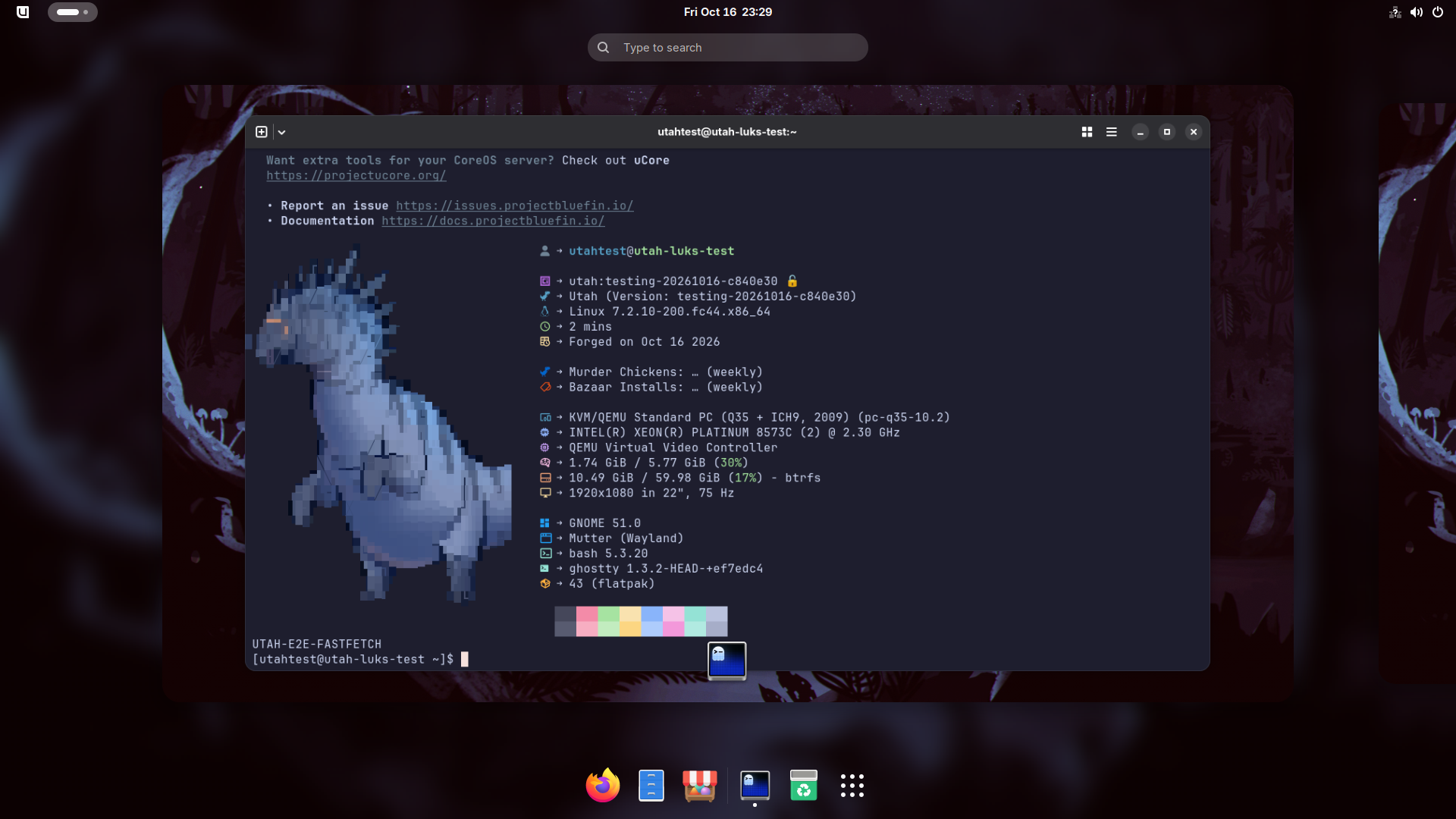
LUKS ISO test passed for commit 8f48ece412bd. CI run; screenshots and provenance.
Bluefin built on Fedora Hummingbird. The more ... civilized murder machine.
Your day keeps getting worse. Why are there more.
Experimental pre-alpha — the image builds, boots, and installs end to end in local QEMU validation: the live ISO's bootc-installer creates a LUKS2-encrypted disk from the ISO's embedded container store with no network, and the installed system boots on its own to GDM and a GNOME session (verified record: docs/verification). None of that is published — no image has been pushed to a registry and no ISO has been released — but the installer and offline payload it exercises are implemented, not a future milestone. Nothing here is ready to run on a machine you care about. Filing issues is the whole point.
What it is
Bluefin built on Fedora Hummingbird (announcement), which supplies a hardened, fast-moving bootable base and no desktop at all. Utah adds the desktop: Bluefin's package contract on top, and the GNOME 51 stack built from source because neither Hummingbird nor a Fedora release ships it.
Two repositories, the way common and brew already work:
| Repository | What it does |
|---|---|
projectbluefin/utah | This one. Composes the image. |
projectbluefin/utah-packages | Builds GNOME 51 and the rest of the desktop stack from verified upstream sources, and publishes them as an OCI image. |
Download
No downloadable Utah artifact is offered yet. No ISO has been released,
and no installer is published. The :testing consumer tag is published
on ghcr.io/projectbluefin/utah, but only after the post-testing-e2e
workflow validates a digest and runs
skopeo copy … "${ref%@*}:testing"
(.github/workflows/post-testing-e2e.yml:311). stream_name: testing in
.github/workflows/build.yml is built with publish_stream_tag: "false",
which only defers the floating :testing tag — it does not block it. The
pipeline also pushes dated testing-<date>-<sha> snapshots to
ghcr.io/projectbluefin/utah for the dispatch-iso job (build.yml:227)
to pick up; those are intermediate artifacts, not a release. Nothing here is
ready to run on a machine you care about, and no download URL is
intentionally offered — see Known gaps for what is and is not
built. Track the publication gate in the
enhancement label on the issue tracker;
the first published artifact will be linked from here and from the Utah
docs page at the same time.
Documentation
The user-facing Utah docs page at
docs.projectbluefin.io/utah is the
canonical home for the live DriverVersionsCatalog (kernel, Mesa, NVIDIA,
GNOME versions, provenance and update date, image switch commands, reboot
guidance). Edit README.md — not the docs wrapper — and the
catalog stays honest because it is generated, not hand-maintained.
Image streams
| Tag | Stream | What it is |
|---|---|---|
:testing | Dev | Built from testing, advanced only after end-to-end validation. |
:stable | Stable | Promoted from :testing. |
Four flavors per stream — utah, utah-nvidia, utah-gaming,
utah-nvidia-gaming — matching Bluefin's. config/flavors.json is the single
source for that set, for the promote and release matrices, and for whether the
kernel cache image gets built at all.
:testing is published on ghcr.io/projectbluefin/utah:testing after the
post-testing-e2e workflow promotes a validated digest
(.github/workflows/post-testing-e2e.yml:288-312). :stable is not yet
published — :stable is what the pipeline is built to produce from a future
promotion off :testing, not something you can pull today.
Package parity with Bluefin
packages/bluefin.toml is a byte-for-byte copy of Bluefin's base.toml at the
upstream revision pinned in packages/.bluefin-parity-ref, and CI diffs it
against that exact revision on every run, so local drift fails the build rather
than being noticed later.
| count | |
|---|---|
| Bluefin contract installed | 61 |
| Utah additions (GNOME 51, base-image parity, device firmware, desktop services) | 122 |
| Genuinely unavailable | 10 |
The install writes its resolved list to /usr/share/utah/contract.txt and the
verify step asserts that file, so the two cannot disagree. The unavailable
row is not limited to the copied contract: it also holds image-level parity
gaps — names Bluefin's published image ships from a build file outside
base.toml, recorded in baselines/bluefin/rpms.tsv and triaged in
baselines/triage.toml (nss-mdns is the current example). The runtime
repository allowlist is asserted both by --check against the .repo files
in packages/ before composition and by the on-image verifier against the
composed image's runtime repositories: every reposdir dnf5 resolves at
runtime from the base image's [main] config (defaulting to
/etc/yum.repos.d, /etc/distro.repos.d, /usr/share/dnf5/repos.d when no
reposdir= is set), so a .repo file the base image ships in any of those
directories is held to the same allowlist. The
verify step retains the resolved origin/NEVRA set with build provenance as
/usr/share/utah/package-origins.json and package-origins.txt. These counts
are generated from packages/bluefin.toml and packages/utah.toml
(scripts/generate-site-data.py, site/data/packages.json); just check
fails if this table drifts from that output (scripts/check-doc-counts.py).
Known gaps
This is the honest list, and it is why the label above says pre-alpha.
- Nothing is released yet. No ISO artifact has been published and no
installer is offered. The
:testingconsumer tag is published on GHCR after validation (see Download); what is missing is a release artifact and a published installer, not the installer payload itself. The live ISO and its bootc-installer payload are implemented and pass an offline, LUKS2-encrypted install end to end in local QEMU validation (just iso,just luks-test; record and screenshots in docs/verification) — what is missing is publication, not the installer. - Live media boot paths and Secure Boot. Live media requires UEFI boot;
legacy BIOS and file-backed/Ventoy booting are explicitly unsupported (flash
directly using Fedora Media Writer or
dd). As a documented exception (Issue #22), live media runs SELinux in Permissive mode (enforcing=0) because rootless container squashfs generation cannot preserve SELinux xattrs; installed target systems boot Enforcing normally. Because the live environment currently usessystemd-boot-unsigned, Secure Boot must be disabled in firmware to boot the live media until signed shim integration is complete. Custom OGC kernels, NVIDIA modules and the v4l2loopback virtual-camera module are all built from source during the image build and unsigned; module signing is not implemented yet, so Secure Boot must be disabled for them to load. - Cross-vendor switch and update timers (
bootc-fetch-apply-updates). Switching to Utah from Bluefin or other bootc images carries Bluefin's/etc/systemd/system/timers.target.wants/bootc-fetch-apply-updates.timersymlink across ostree's 3-way/etcmerge. Utah masksbootc-fetch-apply-updates.timerandbootc-fetch-apply-updates.servicein both/etcand/usr/lib/systemd/system/(and presets them to disabled) so background auto-updates do not bypassuupdpolicy or silently undo a rollback (bootc rollback). Switchers should verify withsystemctl is-enabled bootc-fetch-apply-updates.timerand can re-assert the mask (systemctl mask --now bootc-fetch-apply-updates.timer bootc-fetch-apply-updates.service) if a merged/etcwants symlink remains on disk (links #17, #101). - systemd-boot installs keep their ESP through
bootctl, notbootupd. On a system that boots through systemd-boot — for example one switched over from Dakota —bootupdstands down by design and reports the ESP as "managed with bootctl", sobootupctl statuslists no components. That is expected, not a broken install: Utah shipssystemd-boot-unsignedand enablessystemd-boot-update.service, which runsbootctl updateon each boot that came through systemd-boot, so the boot manager binaries stay current. A drop-in gates that service on theLoaderInfoEFI variable and on Secure Boot being off: BIOS systems have no efivars and skip it outright, Fedora GRUB-EFI systems do setLoaderInfo(grub2 embeds theblimodule) butbootctl updateis a no-op there because it refuses to replace a boot manager it does not recognise as its own, and Secure Boot systems are skipped so the unsigned build cannot overwrite a signedsd-boot. Either way GRUB systems keep getting theirgrubandshimfrombootupd. Switchers can confirm the ESP is being maintained withbootctl status(compareCurrentagainstAvailable) rather thanbootupctl status(links #363). - Wi-Fi package coverage is not hardware validation.
[hardware]inpackages/utah.tomlinstallslinux-firmwareand explicit Intel wireless firmware packages so drivers can load their device blobs.[parity]installs Hummingbird'sNetworkManager-wifitogether with the factory'swpa_supplicant,wireless-regdbandiw; the former factory dependency blocker is resolved. Verify device detection and network association on the target hardware rather than treating the package list as proof that every radio works. - The NVIDIA and gaming flavors are unproven. The OGC kernel compiles with
sched_extandbinderfsgenuinely enabled, and the NVIDIA open module compiles for the base kernel. The module against the OGC kernel, the driver installer flags, and the flavored builds pulling the kernel cache image have not yet all passed in one run. - Codec support differs.
[multimedia_overrides]names are packages Fedora already ships and Bluefin replaces with negativo17 builds. Utah now requests four of those twelve names (intel-gmmlib,libva-intel-media-driver,intel-mediasdk,intel-vpl-gpu-rt) from the factory overlay, pluslibvpl, which is not an overrides name but a dependency ofintel-vpl-gpu-rt. The remaining eight —libheif,libvaand the sixmesa-*names — are not requested by name; whichever build the transaction resolves (the factory publisheslibva, whichlibva-intel-media-drivermay pull in) is recorded in the image's/usr/share/utah/package-origins.txt. Nothing is absent from the image; hardware-accelerated codecs are what differ, and no run has yet proven decode on hardware. Tracked by #383. - The image is still pre-alpha. The digest-pinned
utah-packagesOCI repository is consumed and the local QEMU image reaches GDM and GNOME Shell. - CUDA is deliberately excluded — 7.68 GB installed. Use the NVIDIA container toolkit, which is included, and run CUDA in a container.
See the open issues for where things stand.
Contributing or building from source
See docs/building.md for how to build the image locally, and docs/skills/ for the deep documentation. Agents start at AGENTS.md.
Downloads & Image Versions
UTAH Testing ISO
RecommendedCurrent automated testing build for verification and hardware testing.


Usage
Systems active per day.
Bluefin Utah :stable: accumulating dataBluefin Utah :testing: accumulating dataBluefin Utah :unknown: accumulating data
No raptors reporting in, life finds a way
Release Assets & Attestations
No published GitHub releases found for this product.